
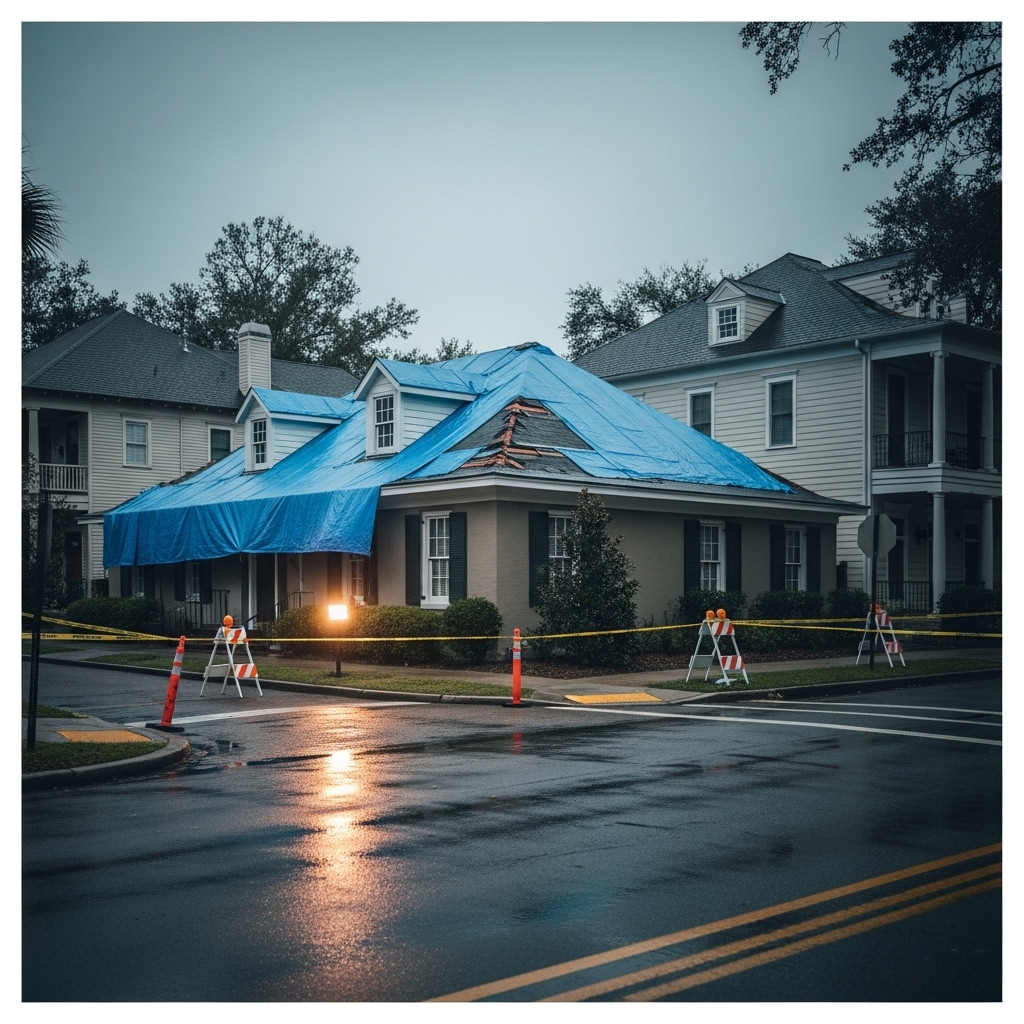
When a storm peels back shingles or sends rain through your ceiling, you don’t need theory. You need a simple plan that keeps your family safe, locks down evidence, and helps you pursue the benefits available under your policy. We try cases for a living, but this guide is about practical moves that help you document fairly so you can rebuild. Outcomes vary; expect responsibility for deductibles and any non-covered costs.
Start Here: Your First 24–48 Hours (Quick Answers)
Is it safe to stay in the home?
Do a quick safety sweep before anything else: - Downed power lines, gas smells, or sparking? Get out and call utilities. - Ceilings sagging or bowing? That can collapse—avoid those rooms. - Active leaks? Put buckets/towels down and keep pets/kids clear.
Can I tarp or do temporary repairs before the adjuster comes?
Yes. Your policy requires you to “mitigate” (prevent further damage). Take photos and video before, during, and after every step. Keep every receipt.
Will my old roof or wear‑and‑tear kill my claim?
Not if you separate pre‑loss condition from storm‑created damage with clear, time‑stamped evidence. Age alone doesn’t automatically bar coverage for new storm damage; policy terms control.
What if the adjuster won’t get on the roof?
You can request a ladder assist, drone inspection, or a reinspection. Prepare your proof now so you’re not starting from zero later.
The First‑Hour Checklist: A Simple System You Can Repeat
Create a claim folder in the cloud: “YYYY‑MM‑DD YourAddress Roofing Claim” and mirror it on a USB.
Start a claim diary (Notes app or spreadsheet):
Every call, text, visit, promise, and deadline. Note date/time, who said what, and next steps.
Turn on photo/video time stamps and location services in your phone.
Mitigate immediately:
Tarp or shrink‑wrap leaks, place buckets, protect contents. Film the water path from roof to room if you can.
Do not discard anything:
Bag damaged shingles, flashing, and underlayment. Label with date/location. This is your “evidence kit.”
Build a one‑page facts sheet:
Date/time of loss, weather (hail size/wind gusts), visible damage, roof material/age, temporary repairs made, who was present.
The Photo + Video Blueprint Adjusters Expect
Exterior Elevations
- Wide shots of all four sides; then mid‑range and close‑ups labeled North/East/South/West.
- Gutters/downspouts for hail spatter; look for paint chips in the bottoms and granule piles near splash blocks.
Roof Surfaces
- Take approach photos up the ladder; then each slope from eave to ridge.
- Capture ridge caps, hips, valleys, rakes, and eaves.
- Soft metals: ridge/turtle/turbine vents, flashing, chimney caps—close‑ups with a coin or tape for scale.
- Shingles/tiles: mid‑shots of 10’x10’ test squares; close‑ups of bruising, creases, missing tabs. Use sidewalk chalk circles to mark impacts (lightly).
- Skylights, solar mounts, satellite mounts; step and counter flashing at walls/chimneys.
Interior & Attic
Ceiling stains, bubbling paint, wet insulation. Include a tape measure in frame; note moisture readings if you have a meter.
What to Include in Every Frame
- A scale object (coin/tape), compass direction, and a quick pan shot to place the location in context.
- Video walk‑through: slow, narrated, no music. “This is the south slope above the kitchen—visible creases near the vent.”
Drone Notes
Great for steep roofs. Retain original .jpg/.mp4 files and any flight logs, consistent with privacy and local rules. If you hire a drone vendor, ask for the full photo package, not just a summary PDF.
Lock In the Date of Loss: Weather Proof That Survives Scrutiny
Pull Independent Weather Data
- NOAA/NWS local storm reports and radar snapshots (e.g., RadarScope screenshots).
- Third‑party hail/wind reports with an address pin (HailTrace, CoreLogic, Canopy Weather).
Document Locally With Precision
Tie your address to recognizable, neutral landmarks or intersections (e.g., near the 17th Street Canal, Buckhead Village, the Galleria area, Courthouse Rd & 2nd St, Downtown Crossing/Old City Hall).
Reference nearby weather stations:
KNEW (New Orleans Lakefront), KATL (Atlanta), KHOU (Houston Hobby), KGPT (Gulfport‑Biloxi), KBOS (Boston Logan).
Save timely headlines/social posts about the storm and street‑level photos of neighborhood tarps and downed limbs (avoid faces/license plates).
Know Your Policy in 20 Minutes: The Focused Read That Matters
Grab These Pages and Flag These Terms
- Declarations page, wind/hail endorsement, deductible schedule.
- Ordinance or Law (code upgrade) coverage; matching/cosmetic damage exclusions.
- Valuation: ACV (actual cash value) vs RCV (replacement cost value) for roofs; depreciation/holdback rules.
- Deadlines: prompt notice, proof of loss, and suit limitation clauses.
- Create a “setlist” sheet: carrier, policy number, claim number, coverages/deductibles, key exclusions you expect to be cited—mapped to your evidence.
Temporary repairs the insurer will pay for (if you document them right)
Tarp/shrink‑wrap install:
Before/after photos, the path of water, daily photos if weather continues.
Keep line‑item receipts: materials, labor hours, rental equipment, dump fees.
Don’t over‑repair pre‑inspection:
Stabilize; don’t replace. If you must remove dangerous sections, preserve samples and photograph each step.
Interior mitigation:
Dehumidifier logs, daily moisture readings, photos of baseboards/floors gently lifted to dry.
Contractor and estimator strategy—without signing away your rights
Vet the pro
Local, licensed, insured. Ask for:
A sample photo report and a line‑item estimate (Xactimate or comparable).
Red flags:
“We’ll waive your deductible,” high‑pressure door‑knocking, assignments of benefits (AOB), or “you must hire us if insurance approves.”
Green flags:
Manufacturer training, code‑citation experience, willingness to meet the adjuster to calmly discuss scope.
Ask for deliverables you can hand the adjuster
- Roof diagram with squares and pitch; marked damage map; photo index.
- Line‑item scope with materials; code citations (ice/water shield, drip edge, valley metal).
- Manufacturer guidance pages showing repair limits and when full replacement is required after creasing or hail mat fracture.
Build a bulletproof damages narrative: cause, scope, and cost
Cause:
Hail size/wind speeds on your date; directional indicators (creased tabs on leeward side, spatter on soft metals).
Scope:
Every slope, accessory, and related component—flashing, vents, gutters, skylights, satellite removal/reset, HVAC fin damage.
Cost:
RCV/ACV math, local pricing, and code upgrades required to pass inspection. Include permits/inspection fees.
Prove pre‑loss condition/age:
Prior invoices/permits, home inspections, HOA letters, past photos—even Google Street View history.
Communicate Before the Visit (Script + Setup)
File the claim with a script
- “We sustained storm‑created openings and active leaks beginning on [date/time]. Temporary repairs are in progress; photos and weather reports are available.”
- Ask for written acknowledgment, your claim number, and the adjuster’s contact info/inspection window.
What Not to Do
- Don’t guess roof age or concede causation (“it’s just old”).
- Don’t give a recorded statement yet if facts are still developing.
Schedule the Inspection On Your Terms
- Request a roof‑walking adjuster or ladder assist; confirm they’ll inspect every slope and soft metals.
- Try to have your contractor present. You control the narrative with facts, not arguments.
Ask for Deliverables
“Please provide your full photo set and the written scope/estimate used to value this roofing claim.”
Your Inspection Packet (Hand This Over)
Table of contents:
One‑page facts sheet; weather reports; photo index; contractor diagram/estimate; temporary repair receipts; bagged sample log.
USB or shared folder link with original‑resolution files and clear file names (YYYYMMDDNorthSlopeRidgeVent_01.jpg).
A short, calm checklist:
“Please confirm inspection of north/east/south/west slopes, valleys, ridge caps, all flashing, skylights, and attic.”
Preserve a Clear Paper Trail (Without Being Adversarial)
Track timelines and promises in your claim diary
Note statutory acknowledgment, investigation, and payment deadlines. If things stall or you see lowballing, your notes matter.
Helpful state references (general information only—confirm current law. Consult a qualified attorney)
- Louisiana: La. R.S. 22:1892 and 22:1973 (insurers must pay timely and act fairly; penalties can apply if they don’t).
- Texas: Prompt Payment of Claims Act (Texas Insurance Code Chapter 542) and unfair practices (Chapter 541).
- Georgia: Unfair Claims Settlement Practices (O.C.G.A. 33‑6‑34).
- Mississippi: Unfair Claims Settlement Practices (Miss. Code Ann. 83‑5‑301; related regulations).
- Massachusetts: Chapters 93A and 176D (unfair/deceptive practices and unfair claim settlement standards).
Send polite deadline reminders by email and certified mail with your evidence attached or linked.
If You’re Denied or Underpaid: Decision Tree
Ask for a reinspection:
Include your contractor’s findings and any new photos. Request the carrier’s full photo set and any engineering reports.
Consider appraisal if your policy allows and the dispute is price/scope—not coverage.
If the carrier alleges wear‑and‑tear only:
Gather manufacturer repairability limits, brittle test results (done safely), and soft‑metal impact evidence to rebut.
When to call an attorney who actually tries property insurance claims:
- Patterns of delay/deny/deflect, refusal to inspect all slopes, ignoring weather evidence, or “cosmetic only” denials where function is impaired.
- We’re local and on the ground in Metairie, Atlanta, Houston, Gulfport, and Boston. We litigate roofing claims and, when needed, bad faith.
Local Quick‑Help Touchpoints
Permits/Codes (print applicable excerpts for drip edge/ice & water shield/valley metal)
Jefferson Parish/New Orleans OneStop; City of Atlanta Permits; City of Houston Permitting Center; Gulfport Building Department; Boston Inspectional Services.
Medical/Safety After Storms
If someone is injured:
Ochsner Medical Center (Metairie); Emory University Hospital Midtown (Atlanta); Houston Methodist near the Galleria; Memorial Hospital at Gulfport; Massachusetts General Hospital (Boston).
Fast FAQs (Real Questions We Get)
What photos do I need for a roofing claim?
Wide/mid/close of each elevation and slope, soft metals, interiors—with a scale in frame and compass direction noted.
Can I tarp my roof before the adjuster?
Yes. You must mitigate. Document every step and keep receipts.
How do I prove the hail date?
NOAA/NWS reports + third‑party hail maps + street‑level photos + local station IDs (KNEW, KATL, KHOU, KGPT, KBOS).
Do I need multiple estimates?
One detailed, line‑item estimate with code citations beats three vague proposals.
What if my adjuster won’t walk the roof?
Request a ladder assist or reinspection; submit your photo package in advance.
Will my premiums go up?
It varies by carrier/state. Weather losses are often treated differently than at‑fault events. Ask your agent how your specific policy handles it.
Close the Loop: Your Path to a Fair Roofing Claim
Package your evidence, control the inspection, and keep the paper trail tight—those three moves change outcomes. If you’re still not being treated fairly, we can step in—calmly, quickly, and, if needed, in court. Our job is to help you pursue available benefits so you can rebuild. Outcomes vary; expect responsibility for deductibles and any non-covered costs.
Free Claim Packet Review (Before the Adjuster Arrives)
Send us your “inspection packet” for a no-pressure review. No cost to meet and discuss your options. We’ll help you tighten it so you can pursue a fair outcome.
Local help, real people:
- Metairie HQ: 3001 17th Street, Metairie, LA 70002
- Atlanta: 1201 W Peachtree St NW, Suite 600, Atlanta, GA 30308
- Houston: 1 Riverway, Houston, TX 77056
- Gulfport: 204 Courthouse Rd, Suite A, Gulfport, MS 39507
- Boston: 44 School St, 6th Floor, Boston, MA 02108
Reach out at insuranceclaimhq.com. We’re in polos and ball caps most days, but we suit up when it’s time to try your case. Contact us to schedule a no-obligation strategy session.
Attorney Advertising. General information only; not legal advice. Reading this content does not create an attorney–client relationship. Results vary; no guarantee. Representation is limited to jurisdictions where our lawyers are licensed, and we associate with local counsel when required. Contingency-fee representation may be available; court costs and case expenses may be the client’s responsibility as outlined in a written engagement agreement. Coverage outcomes depend on specific policy language and facts—review your policy and deadlines with a qualified attorney licensed in your jurisdiction.