
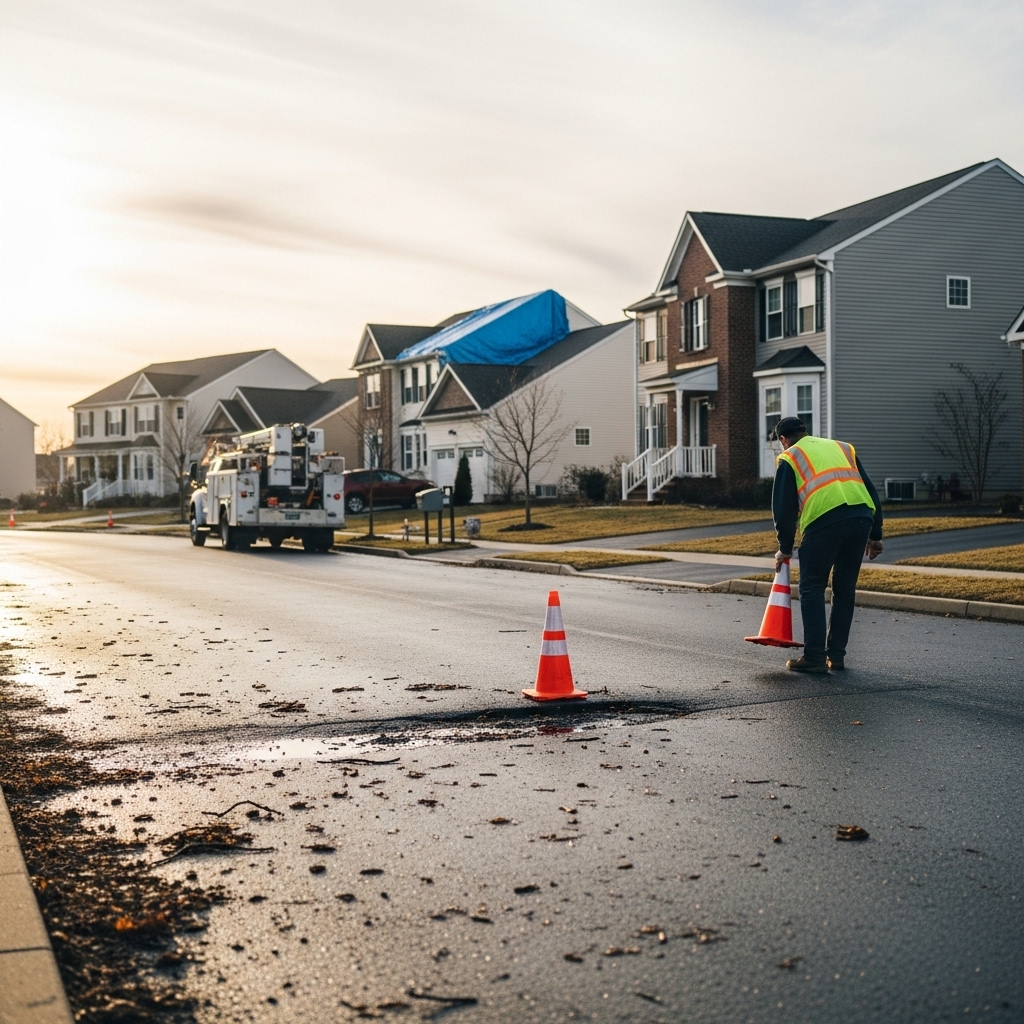
Short answer: not necessarily. Late notice doesn’t automatically bar a wind, hail, or hurricane claim in many situations; policy language and governing law control. Hidden storm damage is common: think lifted shingles that reseal, moisture trapped behind plaster, or hairline cracks that open after freeze/thaw. It’s a bruise under the skin—you don’t always see it on day one.
Below is a plain-English playbook to protect your home or building, your timeline, and your rights.
What “Late Notice” Really Means in Property Claims
It’s notice given weeks or months after the storm because the damage wasn’t visible or got worse over time. After wind or hail, you might later discover:
- Lifted shingles that resealed and now leak during the next big rain
- Cracked tiles/slate that didn’t show until freeze/thaw
- Torn underlayment or fastener pull‑through
- Compromised flashing and ridge caps
- Window/door racking and water intrusion at frames
- Moisture trapped in wall cavities
- Latent punctures in flat roof membranes and hail‑dented soft metals
That’s all still storm, wind, or hail damage. You can—and should—report it when you discover it.
First 72 Hours After Discovery: Protect People, Property, and Your Claim
Put safety first and mitigate:
- Stop active water intrusion (tarp/board-up), shut off power to wet areas, run dehumidifiers and fans.
- Keep every receipt. Mitigation costs are usually covered.
Start a simple claim diary:
Dates, who you spoke with, what you saw, weather at the time, photos/video. Save voicemails and emails.
Build a “late‑discovery” timeline:
Storm date; first signs (stains, odors, ceiling sag, utility spikes); what triggered discovery (attic check, HOA inspection, contractor visit).
Don’t discard damaged materials:
If you must remove them for safety, photograph before/during/after, bag, label, and store.
Pull your full policy package:
Declarations page, hurricane/named storm endorsement, anti-concurrent causation clause, mold limits, suit-limitation clause, appraisal clause, proof-of-loss requirements.
Know Your Real Deadlines: “Notice,” “Proof of Loss,” and “Suit Limitation” Are Different
- Notice: Most policies say “prompt” or “as soon as practicable.” If you discovered the loss late, explain why—then notify immediately.
- Proof of Loss: Often due 30–60 days after the carrier asks for it. The clock typically starts when they request it in writing.
- Suit limitation: Many policies require you to sue within 1–2 years of the date of loss (sometimes tolled). Don’t assume the state’s general statute controls—read your policy.
- Recoverable depreciation: Some policies include deadlines to recover depreciation. Confirm your policy and request extensions in writing where permitted.
- Prompt‑pay rules still apply: Late notice doesn’t erase the insurer’s duty to investigate and pay undisputed amounts timely.
Examples:
- Louisiana: Insurers face penalties for arbitrary/capricious underpayment or late payment after satisfactory proof of loss (La. R.S. 22:1892, 22:1973).
- Texas: Prompt Payment of Claims Act (Texas Insurance Code ch. 542) can add interest and fees for late payment.
Build Proof That Your “Late” Damage Is Storm‑Related
Evidence kit:
Exterior:
High-res slope-by-slope roof photos, close-ups of creased shingles, hail bruising, spatter marks, dented vents/gutters, cracked tiles or slates, displaced ridge caps, damaged parapet caps.
Interior/attic:
Moisture readings, thermal imaging, ceiling/wall staining progression, wet insulation, daylight through decking, rusted fasteners.
Envelope/systems:
Window/door racking, stucco or EIFS impact marks, HVAC hail-damaged fins, damaged fascia/fences.
Professional support:
- Independent roofer/building consultant report with a clear causation narrative (avoid “free roof” pitches that lack detail).
- Licensed engineer for structural/causation—critical when the carrier claims “wear and tear” or “repeated seepage.”
Meteorologist/hail swath mapping:
NOAA/NWS storm reports; radar-based hail/wind footprints tied to your address and date.
Paper trail:
- Maintenance logs, HOA minutes, prior inspections, and permits. Lack of prior issues supports late discovery.
- Neighbor affidavits and contractor statements: “We first observed damage on [date] during [inspection type].”
How to file or reopen a “late notice” wind/hail claim the right way
Notice letter/email:
Identify the storm date, your discovery date, why it wasn’t discoverable earlier, and that you mitigated promptly.
Ask for:
A complete policy copy (all endorsements); inspection within 10–14 days; written confirmation of all deadlines; and the carrier’s claim-handling guidelines if available.
Control your statements:
Decline a recorded statement until you’re prepared. If it’s required, prepare with counsel and use your evidence and timeline.
Proof of Loss:
Don’t wait for the carrier to price your loss. Submit a detailed estimate with photos and expert reports; reserve the right to supplement if hidden damage is uncovered.
Keep the property inspection-ready:
Ladders and access available; attic cleared; avoid permanent repairs until after the carrier’s inspection unless safety requires (document thoroughly if you must proceed).
Common insurer defenses—and the counterpunches that work
“Late notice”:
Emphasize prompt notice upon discovery.
In some jurisdictions, late notice defenses consider whether the insurer was prejudiced. Spell out why there is none (damage preserved; comparable damage on other elevations; objective weather data; experts retained). Consult a qualified attorney about how this applies in your jurisdiction.
“Wear and tear/maintenance”:
Use directional wind creasing, uplift testing, edge damage, and hail impact markers to distinguish storm damage from age.
“Repeated seepage/long-term leak”:
Moisture mapping, a clean break in staining timeline tied to the storm date, newly torn sheathing at fasteners—all point to a single event.
“No opening created by wind” (for interior water denial):
Show compromised roof covering, lifted flashing, or torn underlayment as the “opening.” Building code-required tear-off often reveals storm-driven openings.
Anti-concurrent causation (ACC), flood vs. wind:
Separate wind-driven damage from flood impacts; use elevation lines, debris patterns, expert causation, and photos to allocate covered wind loss.
Appraisal, mediation, or litigation—how “late notice” plays in
Appraisal:
- Great for scope/price disputes when coverage is accepted. Less helpful if the carrier denies causation based on late notice.
- Preserve rights: make a targeted demand and avoid waiving bad faith claims. Calendar your policy’s appraisal deadlines.
Mediation or claim review:
Some carriers offer voluntary mediation. It can fast-track hidden damage supplements.
Insurance Claim Litigation:
- File before the policy’s suit limitation expires. Plead covered causes and add bad faith where supported (unreasonable investigation, failure to pay undisputed amounts, misrepresentations).
- Send spoliation letters; secure sample materials; maintain chain of custody on removed components.
Avoid these claim-killers
- Signing “full and final” releases or cashing checks marked as full settlement without a legal review.
- Making permanent repairs before the carrier inspects (unless safety requires—photograph and save materials if you must).
- Throwing out damaged materials or failing to label and store them.
- Letting contractors “speak for you” to the insurer or signing assignments of benefits you don’t understand.
- Missing the suit-limitation date while stuck in endless “reinspection” loops. Calendar everything.
Special playbook for businesses, condos, and HOAs
Governance and documentation:
Board resolutions to file claims; minutes; owner notices; vendor scopes.
Complex roofs/systems:
Flat membranes, RTUs/HVAC hail damage, façade sealants—line up specialty experts early.
Loss accounting:
Business interruption and extra expense; preserve POS/booking data, utility spikes, vendor logs, and staff time.
Phased inspections:
Across buildings and elevations with uniform photo protocols to show consistent storm patterns.
Local, practical anchors (because place matters)
New Orleans/Metairie:
Older roofs around the 17th Street Canal corridor often hide shingle uplift. Attic inspections off West Esplanade and 17th Street catch underlayment tears curbside inspections miss.
Gulfport/Biloxi:
Along US‑90, wind-driven rain on beach-facing elevations causes latent window/door failures. Water tests and infrared scans prove it.
Houston (Riverway/Galleria):
Hail impacts show first on soft metals. Document dents on rooftop HVAC units and parapet caps before summer heat deforms clues.
Atlanta Midtown (W Peachtree):
High-rise balconies and façade sealants suffer wind racking. Engage an envelope consultant to document movement joints and sealant failures.
Boston:
Slate/tile near Beacon Hill and the Financial District hide cracked slates and slipped hooks. “Lift-and-peek” inspections by a qualified slate roofer are key.
Quick answers to the questions clients actually ask
How long after a hurricane can I file?
Usually until the policy’s suit-limitation runs. Late discovery with no prejudice can still be valid—don’t wait.
What if a prior owner missed it?
You can still claim if the loss happened during your policy period and you discovered it later. Timelines and expert causation matter.
We already repaired—are we sunk?
Not necessarily. Provide before/during/after photos, invoices, and contractor statements; retain removed materials if possible.
The estimate is below my deductible—should I drop it?
Not if damage is progressive. A full-scope expert estimate may cross the threshold and unlock depreciation and ordinance/law coverage.
Will my premiums go up if I file?
Hurricanes, wind, and hail are often “cat” events rated across regions. Ask your agent, but don’t forfeit valid coverage you paid for.
What to bring us for a fast, free claim audit
- Your full policy and endorsements
- Any prior claim correspondence
- Your photo/video set and late-discovery timeline
- Contractor/engineer reports
- Receipts for mitigation and temporary repairs
We’ll map your address to verified storm data, scope your damage with our experts, and lay out your next best move—appraisal, supplemental claim, or storm damage litigation. Outcomes vary; expect responsibility for deductibles and any non-covered costs.
Connect with a team that lives this work
Walk-ins by appointment:
- Metairie HQ: 3001 17th Street, Metairie, LA 70002
- Atlanta: 1201 W Peachtree St NW, Suite 600, Atlanta, GA 30308
- Houston: 1 Riverway, Houston, TX 77056
- Gulfport: 204 Courthouse Rd, Suite A, Gulfport, MS 39507
- Boston: 44 School St, 6th Floor, Boston, MA 02108
Remote-friendly: secure uploads and virtual inspections available within days.
Contact: insuranceclaimhq.com | 844-INS-CLAIM (844-467-2524)
We try cases, we rebuild communities, and we’ll talk to you straight—polo-and-baseball-cap style. If you just found hidden hurricane damage, don’t panic and don’t go it alone. Contact us to schedule a no-obligation strategy session and chart a path from late discovery to a fair resolution.
Attorney Advertising. General information only; not legal advice. Reading this content does not create an attorney–client relationship. Results vary; no guarantee. Representation is limited to jurisdictions where our lawyers are licensed, and we associate with local counsel when required. Contingency-fee representation may be available; court costs and case expenses may be the client’s responsibility as outlined in a written engagement agreement. Coverage outcomes depend on specific policy language and facts—review your policy and deadlines with a qualified attorney licensed in your jurisdiction.