
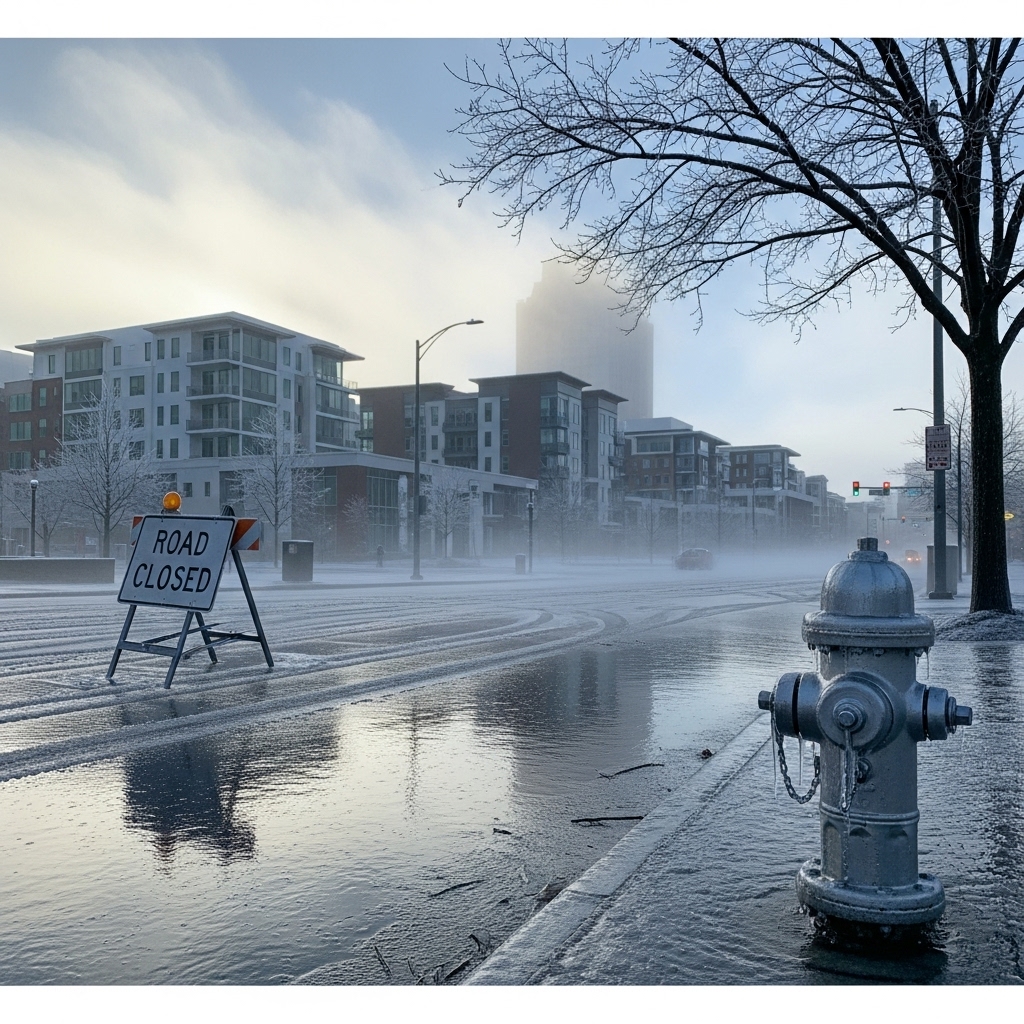
When Atlanta freezes, pipes burst. Water pours through ceilings. Cabinets swell. Floors buckle. Take a breath. This guide walks you through what to do right now, how to protect your claim, and how to push your insurer to pay what it actually takes to rebuild. Our goal is to pursue all benefits available under your policy. Outcomes vary; expect responsibility for your deductible and any non‑covered costs.
From high‑rises in Midtown to older bungalows in Kirkwood and Cascade, the playbook below is a general framework—policy terms control. Focus on stabilization, documentation, and written updates.
1) First things first: you’re standing in water—what now?
Your three immediate priorities:
Safety
- Cut power to wet areas at the breaker.
- Shut off the main water valve.
- Avoid sagging ceilings—keep people and pets out from under them.
Preserve evidence
- Photograph/video everything: every room, baseboard, cabinet toe‑kick, ceiling stain, closet, and the broken pipe itself.
- Save the split pipe/fittings. Bag and label them. Don’t throw them away.
Stop further damage
- Call an IICRC‑certified mitigation company to begin dry‑out within 24 hours.
- Keep every receipt (plumber, mitigation, hotel, supplies).
Why insurers underpay water losses:
- Minimized scope (“patch two drywall panels” instead of continuous paint/texture).
- Ignoring code upgrades and permit costs.
- Over‑depreciation and slow‑walking recoverable depreciation.
- Managed‑repair pressure and lowball estimates.
2) The first 24 hours after a burst pipe in Atlanta: a step-by-step checklist
Shutoff and safety
- Find your main shutoff. In many Midtown/Buckhead homes it’s in the crawlspace or at a curbside street box (a T‑key might be required).
- Bulging ceilings can be hazardous—have a qualified professional relieve pressure and perform repairs.
Call the right pros—fast
Licensed plumber
- Ask for a written cause‑of‑loss report that says “sudden and accidental freeze‑related break” if that’s what happened.
- Photo the failed section before the repair. Keep the damaged pipe.
Mitigation company (IICRC‑certified)
- Require daily moisture readings and psychrometric logs.
- Ask for pre‑ and post‑mitigation moisture maps.
- Photograph the meter showing readings.
Notify your insurer properly
- Report the claim. Get a claim number and the adjuster’s contact.
- Request a certified, complete copy of your policy (all forms and endorsements).
- Start a claim journal: date/time, who you spoke to, what was said. Follow calls with a short confirmation email.
Protect your right to Additional Living Expense (ALE)
- If the home is uninhabitable, move to safe housing. Keep itemized receipts.
- Request ALE advances in writing.
Local touchpoints
- Save Georgia Power outage screenshots if outages contributed.
- Note NWS Peachtree City temperature data for your loss date.
- High‑rise tip (West Peachtree/Midtown): building shutoffs and HOA coordination can delay mitigation. Document management‑caused delays.
3) Denial traps in burst pipe claims (and how to avoid them)
“Late notice” and “failure to mitigate”
Report promptly. Begin dry‑out within 24–48 hours. If vendors are booked, document who you called and when.
“Not maintaining heat” exclusions
Save smart thermostat logs and utility bills. Photograph space heaters or insulation you used. Keep any proof of power outages.
“Continuous or repeated leakage” vs. “sudden and accidental”
Counter with the plumber’s report, freeze-weather data, and the physical condition of the split pipe.
Recorded statements and EUO (Examination Under Oath) pitfalls
- Don’t speculate. It’s okay to say “I don’t know” or “I need to check my notes.”
- You can pause to consult counsel.
Managed repair pressure
In most policies, you may select your own contractor; confirm your policy terms. Avoid broad work authorizations or assignments of benefits that waive rights.
Contents inventory mistakes
Don’t guess values. Use receipts, bank statements, serial numbers, and room-by-room photo sheets.
Premature disposal
Don’t toss wet materials until thoroughly photographed and, when possible, inspected with the carrier. If health requires removal, bag/label samples and keep a chain of custody.
4) Build an evidentiary file the insurer can’t ignore
Core documents
- Plumber report with photos + retained damaged pipe.
- Mitigation logs, daily photos, moisture maps, and meter photos.
- Carrier correspondence + your claim journal.
- Certified policy (including endorsements).
- Weather (NWS) and outage (Georgia Power) records.
Estimating for full value
Obtain a detailed Xactimate estimate that includes:
- Detach/reset, drywall/insulation, flooring, cabinetry, trim, paint, content manipulation, cleaning, and 10% overhead + 10% profit if a GC is reasonably necessary.
- Code upgrades (Ordinance or Law), asbestos/mold testing, permits/inspections, and matching across continuous areas.
Proof of Loss
Don’t sign a sworn Proof of Loss that doesn’t reflect the full scope. Align on scope first.
5) Understanding your Georgia homeowners policy (what actually pays)
Coverages that matter after a freeze
- Dwelling (Coverage A), Other Structures (B), Personal Property (C), ALE/Loss of Use (D).
- Ordinance or Law (code upgrades), Water Damage and Mold sublimits.
- Endorsements (Service Line, Water Backup) if applicable.
How payment works
ACV vs. RCV in plain English:
- ACV (actual cash value) = replacement cost minus depreciation; often paid first.
- RCV (replacement cost value) = full repair cost; you collect the “holdback” after work is completed and documented.
Deadlines matter
“Suit Against Us” clause typically requires suit within 1–2 years from date of loss. Read yours now and calendar it.
Duties after loss (in simple terms)
Tell them promptly, protect the property, show the property, provide documents, give a recorded statement/EUO if required, and submit a Proof of Loss when properly requested.
Appraisal clause
Appraisal can resolve dollar disagreements, but it may limit bad faith leverage. Get advice before you demand or agree to appraisal.
6) Valuation hotspots: where carriers underpay and how to recover full value
Matching and continuity
Uniform appearance across connected spaces (flooring, cabinets, paint/texture). Use line-of-sight arguments and manufacturer discontinuation letters.
Overhead and profit
Include 10/10 when multiple trades and coordination make a GC reasonably necessary.
Code upgrades in Atlanta
City of Atlanta Office of Buildings may require GFCIs/AFCIs, smoke/CO alarms, insulation, anti-scald, pipe freeze protection, and permits/inspections. Include fees and reinspection trips.
Hidden/wet cavities and secondary damage
Behind cabinets, under subfloors, inside chases. Require non-invasive scans and targeted removal where readings stay wet.
Contents valuation
Support with receipts, brand/age research, and fair market comparables. Push back on excessive depreciation.
7) When the insurer delays, underpays, or denies: using Georgia leverage
Bad faith basics (O.C.G.A. § 33-4-6)
Georgia law provides potential penalties and attorney’s fees when bad faith is proven; specific amounts and prerequisites depend on the statute and facts. Talk with a Georgia-licensed attorney about how these remedies apply to your claim.
Regulator complaints
File with the Georgia Office of Insurance and Safety Fire Commissioner. Attach your timeline, photos, reports, and letters.
Appraisal vs. litigation
Appraisal can speed valuation; litigation preserves broader remedies. Strategy depends on your facts, policy language, and the carrier’s conduct.
Preservation letters
Send spoliation notices to the carrier and its vendors. Keep your own evidence secure.
8) Special Atlanta scenarios (condos, high-rises, and businesses)
Condos/high-rises (Midtown, Buckhead)
- Master policy vs. HO-6 responsibilities; common element pipe/sprinkler breaks; potential subrogation against negligent units.
- Coordinate with the HOA but file and protect your own claim deadlines.
Small businesses along Peachtree and the Connector (I-75/85)
Commercial property: water-soaked build-out, equipment, inventory.
Business Interruption:
- Define the “period of restoration.”
- Gather POS reports, payroll, continuing expenses, and extra expense costs.
- Document vendor delays (e.g., elevator shutdowns, building access limits).
Tenants
Renters policies cover contents and ALE. Your landlord must allow mitigation access and address habitability obligations.
9) FAQs people actually ask about burst pipe claims
Does homeowners insurance cover frozen or burst pipes in Georgia?
Usually yes for sudden and accidental discharge. Exclusions may apply for long-term leakage or failing to maintain heat—document your efforts.
What temperature should I keep my home to avoid a denial?
55°F is a common guidance if power is available. Save thermostat logs and utility bills.
What if power outages caused my pipes to freeze—am I still covered?
Often yes. Preserve outage screenshots and NWS temperature records to connect the dots.
How long do I have to file and to sue?
File promptly. “Suit Against Us” is commonly 1–2 years from date of loss. Check your policy and calendar it now.
Can my insurer force me to use their contractor?
In most policies, you may select your contractor; confirm your policy terms and review any managed repair provisions before signing authorizations.
Will a burst pipe claim raise my premium?
It can affect premiums or renewal. The bigger risk is under-repairing your home. Get it paid right.
10) Your money and your mindset: staying sane while you rebuild
We rebuild this like a song—one note, then the next.
Cash flow
- Request ALE and ACV advances. Don’t finance the carrier’s delay.
- Negotiate progress payments tied to milestones (demo complete, dry-out complete, rough-in complete, finishes complete).
Communication
- Send weekly written updates to your adjuster with 3 bullet points: what’s done, what’s next, what you need from them.
- Keep approvals in writing. Share a simple task list with your household.
11) How our team helps policyholders pursue available benefits
What we do immediately
- Retrieve and analyze your full policy.
- Inspect the loss with our team and trusted pros (licensed plumbers, IICRC mitigation, building consultants).
- Build a true Xactimate scope, including code upgrades and matching.
- Handle carrier communications and prepare you for statements/EUO.
Litigation posture (if needed)
Depositions, experts, mediation, and a trial-ready strategy that moves numbers. We try cases when that’s what it takes.
Fees and access
Contingency-fee representation available where permitted by law. Court costs and case expenses may be the client’s responsibility, per the engagement agreement. Free consultation at our Atlanta office—no cost to meet and discuss your options:
1201 W Peachtree St NW, Suite 600, Atlanta, GA 30308
12) Ten-minute action plan: do these now
- Shut off water and power to wet areas.
- Call a licensed plumber and an IICRC-certified mitigation firm.
- Start photos/videos and save the broken pipe.
- Request your certified policy from the carrier.
- Open a claim journal and email the adjuster to confirm reporting.
- Ask for ALE advances if you’re displaced.
- Contact Insurance Claim HQ to schedule a no-obligation strategy session. If it’s easier, text or email us your photos so we can triage fast.
13) Atlanta/Georgia resources
- Georgia Office of Insurance and Safety Fire Commissioner — Consumer Services (complaints and guidance)
- City of Atlanta Department of Watershed Management — shutoff/service issues
- Georgia Power — outage maps/screenshots for proof of power loss
- Nearby healthcare during cleanup injuries: Piedmont Atlanta Hospital (Peachtree Rd NW), Grady Memorial Hospital (Jesse Hill Jr Dr SE)
- Vendor tip: Ask for IICRC-certified mitigation techs and licensed, insured plumbers; collect W-9s and invoices for your file
We’re here to get you from chaos back to home. If your insurer is delaying, lowballing, or denying, don’t go it alone.
- Free consultation — Atlanta: 1201 W Peachtree St NW, Suite 600, Atlanta, GA 30308
- Matters are handled by attorneys licensed where required, and we associate with local counsel when needed. Availability may vary by jurisdiction.
- Visit insuranceclaimhq.com to get started
Attorney Advertising. General information only; not legal advice. Reading this content does not create an attorney–client relationship. Results vary; no guarantee. Representation is limited to jurisdictions where our lawyers are licensed, and we associate with local counsel when required. Contingency-fee representation may be available; court costs and case expenses may be the client’s responsibility as outlined in a written engagement agreement. Coverage outcomes depend on specific policy language and facts—review your policy and deadlines with a qualified attorney licensed in your jurisdiction.